



BitteBitteJaJa (Ulu Braun & Roland Rauschmeier) has been working as an artist duo since 1997, developing a practice defined by an open approach to image material, montage and narration. Their work unfolds as an ongoing process rather than aiming toward a fixed outcome. Combining their own material with found footage, they create shifting visual constellations in which elements overlap, displace one another, and only gradually take shape. Their works have been presented internationally in galleries and museums.
A key aspect of their approach lies in the deliberate reduction of controlled authorship. Instead, they employ methods that allow chance, association, and displacement to become active forces within the work. This openness informs the evolving series Cadavres Exquis Vivants, which draws on the surrealist principle of the cadavre exquis and translates it into a contemporary context.
Alongside this series, BitteBitteJaJa produced experimental films that pursue similar strategies of layering, montage, and open narration. Their body of work resists closure and instead remains in a constant state of becoming.
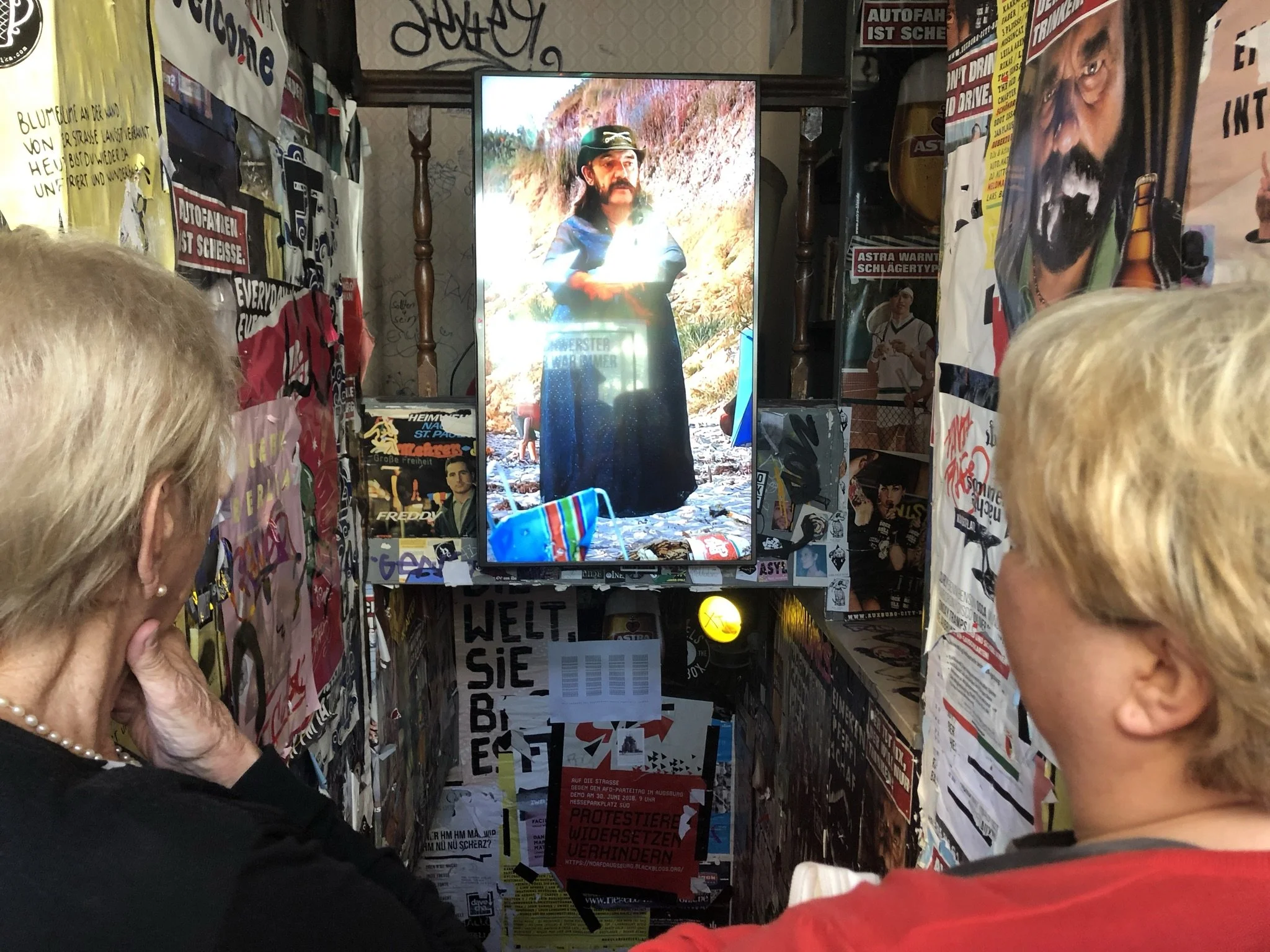
Cadavres Exquis Vivants unfolds as an ongoing series of short video portraits. Initiated around 2007 and continuously developed since, the works take the form of condensed video collages in which historical and cultural figures appear as newly constructed characters, fully immersed in specific actions.
The series draws on the surrealist method of the cadavre exquis, a collective practice based on chance and discontinuity. Translated into the digital realm, BitteBitteJaJa combine found footage and self produced material to construct dense visual compositions. The figures are situated in absurd, often dreamlike settings where narrative coherence dissolves into associative micro dramas.
In this process, portraiture becomes the construction of an alternate reality. Recognizable identities are deconstructed and reassembled, oscillating between caricature, fiction, and symbolic projection. Through an emphasis on instability and transformation, the works destabilize fixed conceptions of subjectivity and extend the strategies of modernist surrealism into the realm of the contemporary moving image.
“[With the] exquisite corpse we had at our disposal – at last – an infallible means of sending the mind’s critical mechanism away on vacation and fully releasing its metaphorical potentialities.”
André Breton, “Le message automatique,” in La Révolution surréaliste, no. 3, 1925.
Reprinted in: André Breton, Œuvres complètes, vol. I, Paris: Gallimard (Bibliothèque de la Pléiade), 1988.
The Cadavre Exquis is a collaborative method that began with the Surrealists in the 1920s. Instead of focusing on individual control, it emphasizes a shared process. Several people create a drawing or text step by step, each responding only to a small part of what came before.
This way of working produces results that are often unexpected. Images and ideas do not fully connect, and meanings stay open. Rather than forming a single, unified work, the pieces remain fragmented, allowing surprising combinations and associations to emerge.
For RauscHmeier and Braun, this method also made it possible to continue working together across distance. Living in different European cities, the principle of Cadavre Exquis helped them sustain a shared artistic process over time, despite not being in the same place.
SERENGETI MUST NOT DIE
Real - time animation
8:30 min, Stereo, mini-DV
1999
„Die Serengeti darf nicht sterben“ is a real-time animated fairytale based on the deadly plane crash of Michael Grzimek in 1959.
The film freely interprets the events after the crash to examine natural selection, human domination over nature, and post-colonialism. Serving as both inspiration and springboard, Bernhard Grzimek's world-famous, Oscar-winning documentary Serengeti Shall Not Die is transformed here into a minimalist, Art Brut raw live-puppet film. The video was shown in several exhibitions/screenings.
INTERFERING WITH WORKS OF OTHERS
18:19 min, Stereo, mini-DV
2004
This documentary “Eingriffe in Arbeiten Anderer” captures a conceptual live painting performance at the Berlinische Galerie in 2002. Six international artists were brought together to collaboratively paint a large canvas under one strict rule: complete the work in exactly 30 minutes. Free from thematic guidelines, participants were permitted to overwrite and alter each other's work at any time, accompanied by interviews reflecting on the medium itself.
However, the experiment took an unscripted turn when an audience member asked to contribute after time had expired. Acting unilaterally, one artist agreed, and the stranger painted a continuous red line across the entire canvas. This intervention triggered an intense conflict over authorship, trust, and collective responsibility. Subsequent attempts to restore the painting escalated the situation further, ultimately affecting adjacent artworks and exposing the fragile ethics of joint artistic production.
REKORDER
19:53 min, Stereo, mini-DV
2007
Rekorder is a process-driven cinematic collage fusing contemporary and archival imagery to articulate an artistic approximation of "Africa."
By blurring the line between producer and performer, the film turns its own creation into its core theme, layering green-screen shots with Ulu Braun's cross-media archive to dismantle visual construction.
Opening with production failures, delays, and raw interventions, the first movement foregrounds the vulnerability of artistic creation and its freedom to address any topic. The middle movement collapses mysticism, reality, analysis, and fiction into a tightly packed sequence where meanings continuously shift. The final movement turns toward pure association, blending poetic visuals and art-historical references under the swell of Bach’s Cantata 106 to favor emotional sovereignty over fixed logic.
Maria Theresia and her 16 children
29:27 min, Stereo, HDV
2011
Artist duo BitteBitteJaJa employ sixteen portraits of Maria Theresia’s children as the anchor for a grotesque, poetic, and subversively satirical essay that re-examines Austria’s deadly serious history through the lens of our media-saturated present. Rejecting traditional visual conventions, the film layers digitally altered archival material with TV clips, commercials, and ethnographic found footage. A Teletubby strolls through an 18th-century royal garden; exotic birds inhabit the Habsburg coat of arms; footage of athletes and factory workers collides with Emperor Franz Joseph and action artist Hermann Nitsch. By embedding contemporary media clutter directly into historic iconography, the work exposes the subtle irony and fragility of national mythology, outlining a speculative vision of Austria's future.